
• Skip to primary navigation
  • Skip to main content
  • Skip to primary sidebar
CMR ASSOCIATES CPA - TAX ACCOUNTING | SPEED ACCURACY | SOLUTIONS

CMR Associates - Tax | Staffing | 401k Audits

Accuracy | Solutions | Speed

  • Services
    • 401(k) Audit Services
      • 401k Pricing Tool
    • Tax Accounting
    • Business Accounting and Fractional CFO
    • Business System Implementation
    • Remote CPA Staffing
    • Business Valuation
  • About Us
  • New Clients
    • Pricing Tool
    • Onboarding
  • Resources
    • Client Portal
    • IRS Authorization
  • Contact Us
  • Show Search
Hide Search

Business Tax Advice

Does your business have to begin collecting sales tax on all out-of-state online sales?

Louisiana Business Accounting - out of state sales tax

Does your business have to begin collecting sales tax on all out-of-state online sales?

You’ve probably heard about the recent U.S. Supreme Court decision allowing state and local governments to impose sales taxes on more out-of-state online sales. The ruling in South Dakota v. Wayfair, Inc. is welcome news for brick-and-mortar retailers, who felt previous rulings gave an unfair advantage to their online competitors. And state and local governments are pleased to potentially be able to collect more sales tax.

But for businesses with out-of-state online sales that haven’t had to collect sales tax from out-of-state customers in the past, the decision brings many questions and concerns.

What the requirements used to be

Even before Wayfair, a state could require an out-of-state business to collect sales tax from its residents on online sales if the business had a “substantial nexus” — or connection — with the state. The nexus requirement is part of the Commerce Clause of the U.S. Constitution.

Previous Supreme Court rulings had found that a physical presence in a state (such as retail outlets, employees or property) was necessary to establish substantial nexus. As a result, some online retailers have already been collecting tax from out-of-state customers, while others have not had to.

What has changed

In Wayfair, South Dakota had enacted a law requiring out-of-state retailers that made at least 200 sales or sales totaling at least $100,000 in the state to collect and remit sales tax. The Supreme Court found that the physical presence rule is “unsound and incorrect,” and that the South Dakota tax satisfies the substantial nexus requirement.

The Court said that the physical presence rule puts businesses with a physical presence at a competitive disadvantage compared with remote sellers that needn’t charge customers for taxes.

In addition, the Court found that the physical presence rule treats sellers differently for arbitrary reasons. A business with a few items of inventory in a small warehouse in a state is subject to sales tax on all of its sales in the state, while a business with a pervasive online presence but no physical presence isn’t subject to the same tax for the sales of the same items.

What the decision means

Wayfair doesn’t necessarily mean that you must immediately begin collecting sales tax on online sales to all of your out-of-state customers. You’ll be required to collect such taxes only if the particular state requires it. Some states already have laws on the books similar to South Dakota’s, but many states will need to revise or enact legislation.

Also keep in mind that the substantial nexus requirement isn’t the only principle in the Commerce Clause doctrine that can invalidate a state tax. The others weren’t argued in Wayfair, but the Court observed that South Dakota’s tax system included several features that seem designed to prevent discrimination against or undue burdens on interstate commerce, such as a prohibition against retroactive application and a safe harbor for taxpayers who do only limited business in the state.

Please contact us with any questions you have about sales tax collection requirements.
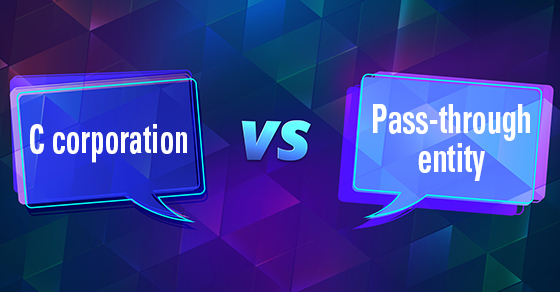
Choosing the best business entity structure post-TCJA

Louisiana Business Accounting C corp vs LLC

Choosing the best business entity structure post-TCJA

For tax years beginning in 2018 and beyond, the Tax Cuts and Jobs Act (TCJA) created a flat 21% federal income tax rate for C corporations. Under prior law, C corporations were taxed at rates as high as 35%. The TCJA also reduced individual income tax rates, which apply to sole proprietorships and pass-through entities, including partnerships, S corporations, and, typically, limited liability companies (LLCs). The top rate, however, dropped only slightly, from 39.6% to 37%.

On the surface, that may make choosing C corporation structure seem like a no-brainer. But there are many other considerations involved.

Conventional wisdom

Under prior tax law, conventional wisdom was that most small businesses should be set up as sole proprietorships or pass-through entities to avoid the double taxation of C corporations: A C corporation pays entity-level income tax and then shareholders pay tax on dividends — and on capital gains when they sell the stock. For pass-through entities, there’s no federal income tax at the entity level.

Although C corporations are still potentially subject to double taxation under the TCJA, their new 21% tax rate helps make up for it. This issue is further complicated, however, by another provision of the TCJA that allows noncorporate owners of pass-through entities to take a deduction equal to as much as 20% of qualified business income (QBI), subject to various limits. But, unless Congress extends it, the break is available only for tax years beginning in 2018 through 2025.

There’s no one-size-fits-all answer when deciding how to structure a business. The best choice depends on your business’s unique situation and your situation as an owner.

3 common scenarios

Here are three common scenarios and the entity-choice implications:

1. Business generates tax losses. For a business that consistently generates losses, there’s no tax advantage to operating as a C corporation. Losses from C corporations can’t be deducted by their owners. A pass-through entity will generally make more sense because losses pass through to the owners’ personal tax returns.

2. Business distributes all profits to owners. For a profitable business that pays out all income to the owners, operating as a pass-through entity generally will be better if significant QBI deductions are available. If not, it’s probably a toss-up in terms of tax liability.

3. Business retains all profits to finance growth. For a business that’s profitable but holds on to its profits to fund future growth strategies, operating as a C corporation generally will be advantageous if the corporation is a qualified small business (QSB). Why? A 100% gain exclusion may be available for QSB stock sale gains. If QSB status is unavailable, operating as a C corporation is still probably preferred — unless significant QBI deductions would be available at the owner level.

Many considerations

These are only some of the issues to consider when making the C corporation vs. pass-through entity choice. We can help you evaluate your options.

2 tax law changes that may affect your business’s 401(k) plan

Louisiana Business Accounting - 401k tax considerations

2 tax law changes that may affect your business’s 401(k) plan

When you think about recent tax law changes and your business, you’re probably thinking about the new 20% pass-through deduction for qualified business income or the enhancements to depreciation-related breaks. Or you may be contemplating the reduction or elimination of certain business expense deductions. But there are also a couple of recent tax law changes that you need to be aware of if your business sponsors a 401(k) plan.

1. Plan loan repayment extension

The Tax Cuts and Jobs Act (TCJA) gives a break to 401(k) plan participants with outstanding loan balances when they leave their employers. While plan sponsors aren’t required to allow loans, many do.

Before 2018, if an employee with an outstanding plan loan left the company sponsoring the plan, he or she would have to repay the loan (or contribute the outstanding balance to an IRA or his or her new employer’s plan) within 60 days to avoid having the loan balance deemed a taxable distribution (and be subject to a 10% early distribution penalty if the employee was under age 59½).

Under the TCJA, beginning in 2018, former employees in this situation have until their tax return filing due date — including extensions — to repay the loan (or contribute the outstanding balance to an IRA or qualified retirement plan) and avoid taxes and penalties.

2. Hardship withdrawal limit increase

Beginning in 2019, the Bipartisan Budget Act (BBA) eases restrictions on employee 401(k) hardship withdrawals. Most 401(k) plans permit hardship withdrawals, though plan sponsors aren’t required to allow them. Hardship withdrawals are subject to income tax and the 10% early distribution tax penalty.

Currently, hardship withdrawals are limited to the funds employees contributed to the accounts. (Such withdrawals are allowed only if the employee has first taken a loan from the same account.)

Under the BBA, the withdrawal limit will also include accumulated employer matching contributions plus earnings on contributions. If an employee has been participating in your 401(k) for several years, this modification could add substantially to the amount of funds available for withdrawal.

Nest egg harm

These changes might sound beneficial to employees, but in the long run they could actually hurt those who take advantage of them. Most Americans aren’t saving enough for retirement, and taking longer to pay back a plan loan (and thus missing out on potential tax-deferred growth during that time) or taking larger hardship withdrawals can result in a smaller, perhaps much smaller, nest egg at retirement.

So consider educating your employees on the importance of letting their 401(k) accounts grow undisturbed and the potential negative tax consequences of loans and early withdrawals. Please contact us if you have questions.

Putting your child on your business’s payroll for the summer may make more tax sense than ever

Louisiana Business Accounting - Tax Savings Kiddie Tax

Putting your child on your business’s payroll for the summer may make more tax sense than ever

If you own a business and have a child in high school or college, hiring him or her for the summer can provide a multitude of benefits, including tax savings. And hiring your child may make more sense than ever due to changes under the Tax Cuts and Jobs Act (TCJA).

How it works

By shifting some of your business earnings to a child as wages for services performed, you can turn some of your high-taxed income into tax-free or low-taxed income. For your business to deduct the wages as a business expense, the work done must be legitimate and the child’s wages must be reasonable.

Here’s an example: A sole proprietor is in the 37% tax bracket. He hires his 20-year-old daughter, who’s majoring in marketing, to work as a marketing coordinator full-time during the summer. She earns $12,000 and doesn’t have any other earnings.

The father saves $4,440 (37% of $12,000) in income taxes at no tax cost to his daughter, who can use her $12,000 standard deduction (for 2018) to completely shelter her earnings. This is nearly twice as much as would have been sheltered last year, pre-TCJA, when the standard deduction was only $6,350.

The father can save an additional $2,035 in taxes if he keeps his daughter on the payroll as a part-time employee into the fall and pays her an additional $5,500. She can shelter the additional income from tax by making a tax-deductible contribution to her own traditional IRA.

Family taxes will be cut even if an employee-child’s earnings exceed his or her standard deduction and IRA deduction. Why? The unsheltered earnings will be taxed to the child beginning at a rate of 10% instead of being taxed at the parent’s higher rate.

Avoiding the “kiddie tax”

TCJA changes to the “kiddie tax” also make income-shifting through hiring your child (rather than, say, giving him or her income-producing investments) more appealing. The kiddie tax generally applies to children under age 19 and to full-time students under age 24. Before 2018, the unearned income of a child subject to the kiddie tax was generally taxed at the parents’ tax rate.

The TCJA makes the kiddie tax harsher. For 2018-2025, a child’s unearned income will be taxed according to the tax brackets used for trusts and estates, which for 2018 are taxed at the highest rate of 37% once taxable income reaches $12,500. In contrast, for a married couple filing jointly, the 37% rate doesn’t kick in until their taxable income tops $600,000. In other words, children’s unearned income often will be taxed at higher rates than their parents’ income.

But the kiddie tax doesn’t apply to earned income.

Other tax considerations

If your business isn’t incorporated or a partnership that includes nonparent partners, you might also save some employment tax dollars. Contact us to learn more about the tax rules surrounding hiring your child, how the kiddie tax works or other family-related tax-saving strategies.

The TCJA changes some rules for deducting pass-through business losses

Louisiana Business Accounting - Deduct Pass through losses

The TCJA changes some rules for deducting pass-through business losses

It’s not uncommon for businesses to sometimes generate tax losses. But the losses that can be deducted are limited by tax law in some situations. The Tax Cuts and Jobs Act (TCJA) further restricts the amount of losses that sole proprietors, partners, S corporation shareholders and, typically, limited liability company (LLC) members can currently deduct — beginning in 2018. This could negatively impact owners of start-ups and businesses facing adverse conditions.

Before the TCJA

Under pre-TCJA law, an individual taxpayer’s business losses could usually be fully deducted in the tax year when they arose unless:

  • The passive activity loss (PAL) rules or some other provision of tax law limited that favorable outcome, or
  • The business loss was so large that it exceeded taxable income from other sources, creating a net operating loss (NOL).

After the TCJA

The TCJA temporarily changes the rules for deducting an individual taxpayer’s business losses. If your pass-through business generates a tax loss for a tax year beginning in 2018 through 2025, you can’t deduct an “excess business loss” in the current year. An excess business loss is the excess of your aggregate business deductions for the tax year over the sum of:

  • Your aggregate business income and gains for the tax year, and
  • $250,000 ($500,000 if you’re a married taxpayer filing jointly).

The excess business loss is carried over to the following tax year and can be deducted under the rules for NOLs.

For business losses passed through to individuals from S corporations, partnerships and LLCs treated as partnerships for tax purposes, the new excess business loss limitation rules apply at the ownerlevel. In other words, each owner’s allocable share of business income, gain, deduction or loss is passed through to the owner and reported on the owner’s personal federal income tax return for the owner’s tax year that includes the end of the entity’s tax year.

Keep in mind that the new loss limitation rules apply after applying the PAL rules. So, if the PAL rules disallow your business or rental activity loss, you don’t get to the new loss limitation rules.

Expecting a business loss?

The rationale underlying the new loss limitation rules is to restrict the ability of individual taxpayers to use current-year business losses to offset income from other sources, such as salary, self-employment income, interest, dividends and capital gains.

The practical impact is that your allowable current-year business losses can’t offset more than $250,000 of income from such other sources (or more than $500,000 for joint filers). The requirement that excess business losses be carried forward as an NOL forces you to wait at least one year to get any tax benefit from those excess losses.

If you’re expecting your business to generate a tax loss in 2018, contact us to determine whether you’ll be affected by the new loss limitation rules. We can also provide more information about the PAL and NOL rules.

  • « Go to Previous Page
  • Page 1
  • Interim pages omitted …
  • Page 12
  • Page 13
  • Page 14
  • Page 15
  • Page 16
  • Interim pages omitted …
  • Page 21
  • Go to Next Page »

Primary Sidebar

Tax. Accounting. Solutions.

Need a good accountant? We can help. Serving clients globally, we embrace distributed work environments. Book a call to learn more.

About CMR Associates

Covington CPA and Tax Accountants Team

Tax Accounting, 401k Audits, and Business Consulting: We provide tax accounting, 401k Audit, business accounting, Outsourced CFO, back-office CPA staffing, business system implementation, payroll support, business valuation, consulting, and …

Publication by CMR Associates

Charles Renwick CPA

All of the latest publications from the directors and staff at CMR …

TAX NEWS AND ADVICE

  • Business Tax Advice
  • Individual Tax Advice
  • Outsourced Accounting
  • Personal Finance
  • Remote Work

Terms and Conditions
Outsourced Accountant CPA
All the Presidents’ Taxes
401k Audit Services CPA

Get solutions today with CMR Assocaites. Learn More

CMR Associates - Tax |  Staffing | 401k Audits

© 2026 · Sitemap

  • Services
  • About Us
  • New Clients
  • Resources
  • Contact Us